Airlines made $7.4 billion from baggage fees in 2023. That money came from passengers who either didn't know the rules, didn't prepare, or got caught at the gate having gambled that no one would check. Traveling with a carry-on only eliminates most of these charges entirely — if you know how to pack to the airline's limits.
Know what you're actually working with
The first mistake is assuming you know your airline's baggage policy. Policies differ between airlines, between fare classes on the same airline, and between routes. A carry-on that's fine on a domestic US flight may be checked and charged on a European low-cost carrier. A bag you've carried on for years may suddenly get measured at the gate because the flight is full and they're looking for checked bags.
Before you pack anything: look up your specific airline's current carry-on dimensions and weight limits for your specific ticket type. Not what you remember from last time. The current limits, for this booking.
The dimensions that matter most are usually height × width × depth combined. Most European low-cost carriers (Ryanair, Wizz Air, easyJet) — the airlines that often appear when you book a holiday without a travel agent — have significantly more restrictive carry-on allowances than full-service airlines. Ryanair's maximum cabin bag dimensions, for example, are 40cm × 20cm × 25cm for the smallest included bag — which is extremely limited. If you have a standard carry-on suitcase you bought for a US carrier, it may not fit their gauge at all.
Weighing limits vary as much as dimensions. Some airlines have no carry-on weight limit. Some have strict 7kg limits. Know yours.
The right bag is half the battle
Soft-sided bags compress and squeeze into overhead bins more easily than hard-sided ones. For carry-on travel, a soft-sided bag that's technically at or slightly above the dimension limit often passes because it compresses to fit. A hard-sided case cannot compress and will fail a gauge test at its stated dimensions.
Backpacks and soft duffels have another advantage: they wear on your body rather than rolling, which makes them practically harder to measure at the gate. Airlines technically should measure any bag, but in practice they measure fewer backpacks than wheeled cases. This is not guaranteed — don't rely on it if your bag is significantly oversized — but it's a real pattern.
For budget airline travel specifically — the kind of fares you find when you search for cheap flights every time — invest in a bag that's certified to the most restrictive carry-on dimensions you regularly fly. The Ryanair or easyJet maximum is the benchmark. A bag bought specifically to those dimensions will never be charged, regardless of how strictly they're enforcing on a given day.
The packing approach that fits more in less space
Rolling clothes is not better than folding for most items. It's better for some things and worse for others, and the relevant metric is how much space you're creating versus how much you're wasting.
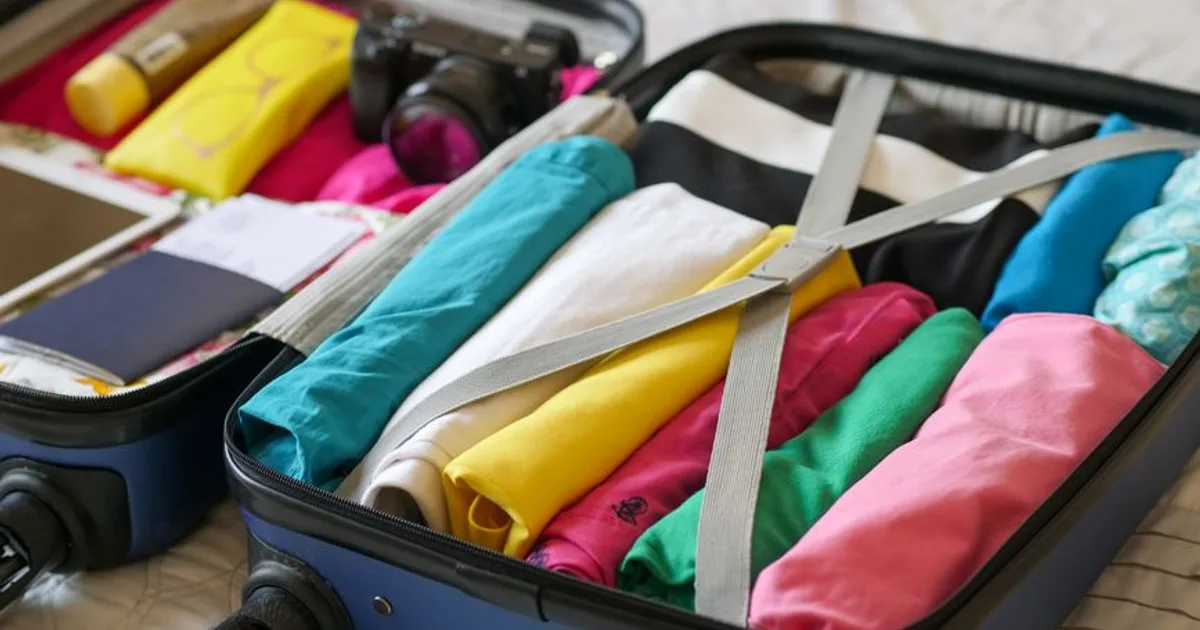
What rolls well: t-shirts, underwear, socks, light trousers, casual shirts. Rolling these items and packing them vertically in the bag (file-style, so you can see everything at once) allows you to see and access everything and generally uses space more efficiently than flat stacking.
What folds flat: structured items, jackets, anything that wrinkles badly when rolled. Fold these flat on top.
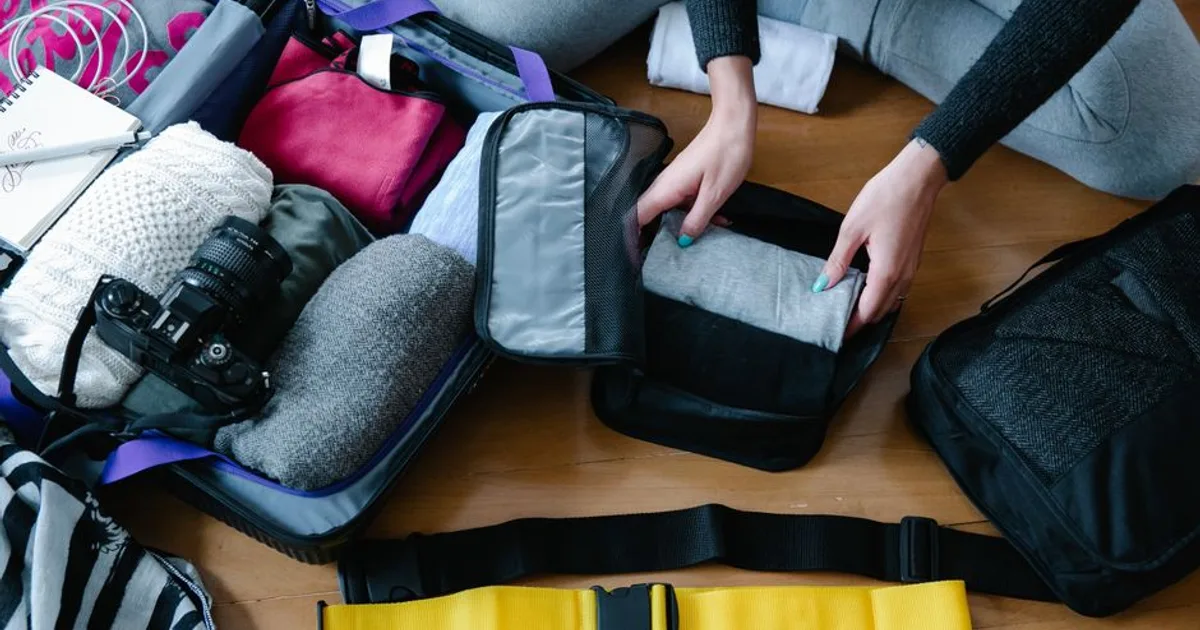
What goes in shoes: socks, phone charger cables, small items. Shoes take disproportionate space for what they are. Pack smaller items inside them to recover some of that volume.
The bundle packing method — wrapping clothes around a central core of soft items — produces very wrinkle-free results and is genuinely efficient for space, but takes longer and requires unpacking everything to access any single item. Worth knowing; not for everyone.
Compression bags are useful for bulky items like down jackets, heavy knitwear, or anything that takes more space than its weight justifies. A down jacket that takes a quarter of your bag can be compressed to a fist-sized bundle. This is one of the most space-efficient tools available and genuinely works.
What to cut to make the weight
Most overpacked bags are heavy because of: too many shoes, too many "just in case" items, full-sized toiletries, and books or other heavy non-clothing items.
Shoes. Wear your heaviest pair on the plane. Pack one additional pair maximum for trips under a week — enough for a weekend trip without overpacking. The default is two pairs (worn plus one), not three or four.
Toiletries. Full-sized shampoo, conditioner, body wash, and moisturiser together can weigh 700g–1kg. Decant into 100ml travel bottles or switch to solid bars (shampoo bars and soap bars add almost no weight and don't count toward liquid limits). If you're staying in a hotel, the hotel will have shampoo and body wash.
The "just in case" items. The coat you'll probably want, the shoes for the dinner that probably won't happen, the book you might read on the plane. Ask specifically what you'll definitely use rather than what you might use.
Electronics and cables. A full charging kit — laptop, tablet, phone, camera, headphones — with cables for each can weigh 2–3kg. Consolidate chargers where possible. USB-C multi-device chargers have reduced this significantly for most people.
At the airport: the moments that matter
The gate is where bags get checked and charged most aggressively. If the flight is full, gate agents are looking for bags to volunteer for checking — and bags that appear oversized are the easiest targets.
If you're travelling with a bag that's close to the limit, board early. Priority boarding, early check-in, or simply being in the first boarding group means overhead bin space is available and gate agents are less focused on measuring bags.
If you're asked to check a bag at the gate after already passing security, ask about the fee before handing it over. Gate checking is sometimes free (if the overhead bins are genuinely full), sometimes charged at a lower rate than counter checking, and occasionally charged at a higher rate as a penalty for carrying an oversized bag. Knowing the fee before committing gives you the option to reconsider.
Wearing your heaviest clothes and putting items in your pockets before a weigh-in is a legitimate strategy that works. A jacket with multiple pockets can carry 2–3kg of items — phone, chargers, book, camera — that would otherwise be in the bag being weighed. Airlines can and occasionally do weigh jacket pockets if they suspect this, but most don't.
For checked baggage: the same principles at scale
Everything above applies to checked bags, just with larger dimensions. The added concern is the overweight fee — most airlines charge significantly for bags over 23kg (50lbs), with fees often exceeding the original ticket price for the most egregious overages.
Weigh your bag at home. A luggage scale costs under £10 and pays for itself the first time you use it. If you're at 22kg, you can redistribute. If you're at 27kg, you need to make cuts or accept the fee. Finding out at the airport check-in desk when it's too late to do much about it is avoidable.
The simplest framework: weigh everything before you leave home, know your limits, and wear anything that's heavy on the plane rather than packing it. Solo travellers especially benefit from a single well-packed carry-on that stays with them at all times.